Chapter 3: Slow geographic atrophy—or GA—with IZERVAY (avacincaptad pegol).
Let's talk about IZERVAY.
IZERVAY is a prescription eye injection that is an FDA-approved treatment proven to slow GA progression.
It's important to know some safety information about IZERVAY. Do not take IZERVAY if you have an infection or active swelling in or around your eye. Watch this entire video for more Important Safety Information.
So, how does IZERVAY work?
In people with GA, a part of the immune system becomes overactive.
A protein...
...called C5...
...signals other proteins to start attacking retinal cells.
Only IZERVAY...
...blocks the C5 protein to help protect healthy retinal cells and photoreceptors.
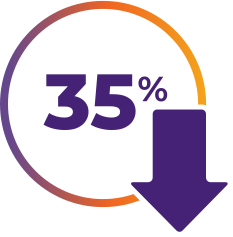
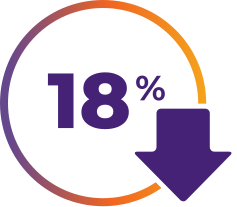
IZERVAY is proven to slow GA progression...
...which may help preserve vision longer. IZERVAY is an eye injection...
...given in the office by your doctor.
The idea of an eye injection may sound scary, but it is a common medical procedure.
To prepare, your doctor will clean and numb your eye to help reduce discomfort.
The injection typically takes a few seconds. You may feel pressure in the eye but, usually, little to no pain. Afterwards, you may experience eye redness, blurry vision, or an increase in eye pressure.
It's important to follow your doctor's post-treatment care instructions...
...and call them right away if you think you might be experiencing side effects.
Staying on treatment as recommended by your doctor is important to receive the full benefits of IZERVAY.
The earlier you slow GA progression, the longer you may preserve your vision.
Hmm...
So, what's important to you as you think about your vision?
Hmm...
Don't delay. Talk to your doctor about...
...slowing GA—with IZERVAY!
Stay tuned for Important Safety Information, and then the main feature—you, teaming up with your doctor.
USE AND IMPORTANT SAFETY INFORMATION
What is IZERVAY® (avacincaptad pegol intravitreal solution)?
IZERVAY is a prescription eye injection, used to treat geographic atrophy (GA), the advanced form of dry age-related macular degeneration (AMD).
IMPORTANT SAFETY INFORMATION
Do NOT receive IZERVAY if you:
- Have an infection in or around your eye
- Have active swelling in or around your eye that may include pain and redness
IZERVAY can cause serious side effects including:
- Eye Infection and Retinal Detachment: Eye injections like the one for IZERVAY can cause an eye infection (endophthalmitis) or separation of layers of the retina (retinal detachment).
- Wet Age-Related Macular Degeneration (AMD): There is a risk of developing wet AMD with IZERVAY. You should report any symptoms (visual distortions such as straight lines seeming bent, deterioration in vision, dark spots, loss of central vision) to your healthcare provider to monitor.
- Increase in Eye Pressure: IZERVAY may cause a temporary increase in eye pressure after the injection. Your healthcare provider will monitor this after each injection.
Call your healthcare provider right away if you have redness of the eye, eye pain, increased discomfort, worsening eye redness, blurred or decreased vision, an increased number of small specks floating in your vision, flashes of light, or increased sensitivity to light.
Before receiving IZERVAY tell your healthcare provider about all of your medical conditions including if you:
- Have a history of seeing flashes of light or small specks floating in your vision and if you have a sudden increase of size and number of these specks.
- Have high pressure in the eye or if you have glaucoma.
- Are pregnant or breastfeeding, think you may be pregnant, or are planning to have a baby, ask your doctor for advice before taking this medicine.
- Are taking any medications, including prescription and over-the-counter medicines, vitamins, and herbal supplements. Tell your healthcare provider about any medicine you take.
What should I avoid while receiving IZERVAY?
- Your vision may be impaired after receiving an eye injection or after an eye exam. Do not drive or use machinery until your vision has recovered sufficiently.
What are the most common side effects of IZERVAY?
- Blood in the white of the eye
- Blurred vision
- Increase in eye pressure
- Wet AMD
- Mild corneal irritation
- Eye pain
These are not all the possible side effects of IZERVAY. Tell your healthcare provider about any side effect that bothers you or that does not go away.
Call your healthcare provider for medical advice about side effects. You are encouraged to report negative side effects of prescription drugs to the FDA. Visit www.fda.gov/medwatch, or call 1-800-FDA-1088.
Please see accompanying full Prescribing Information.